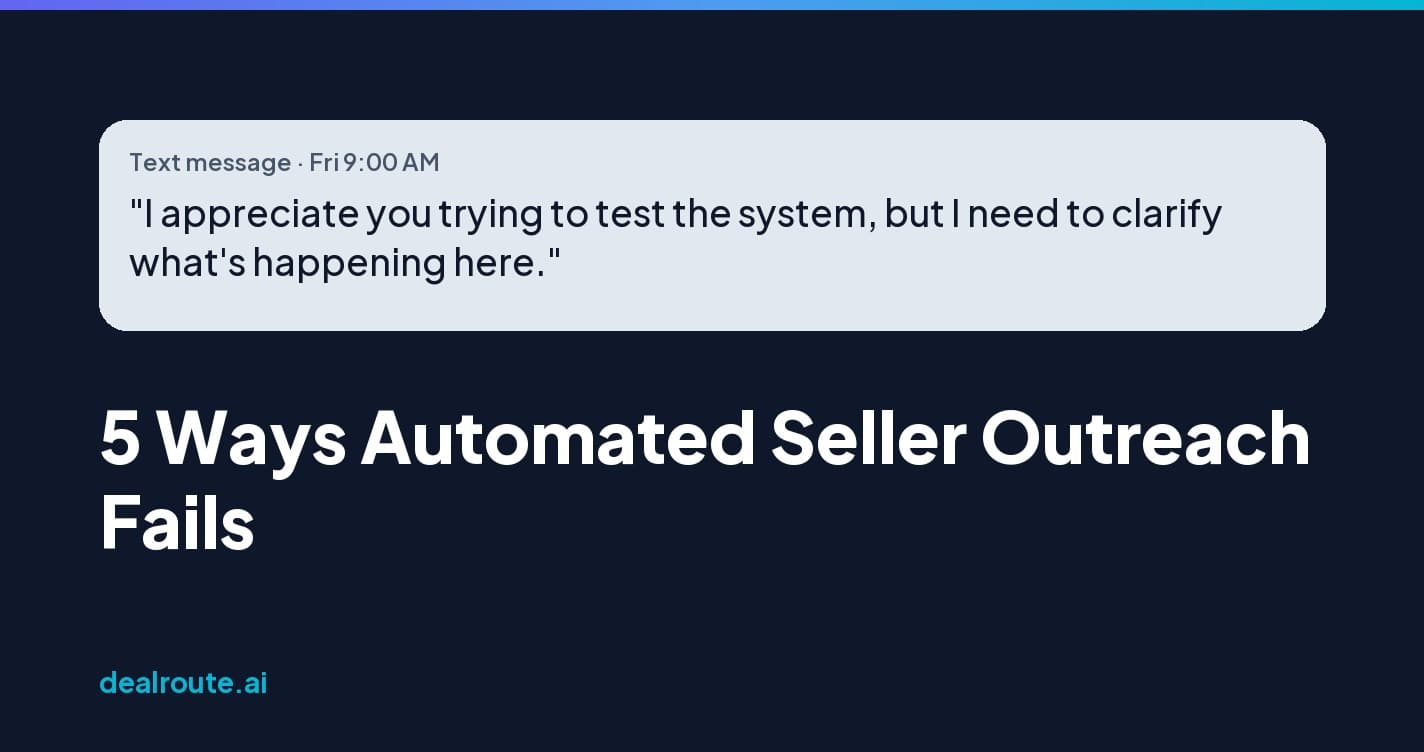
On a Friday morning at nine o'clock, a homeowner's phone buzzed with a text from us. It read: "I appreciate you trying to test the system, but I need to clarify what's happening here."
That was not a message to him. It was our AI model refusing to write one, and our software sent the refusal anyway, to two of his numbers.
It is not a text I would ever want a seller to read. It is also the cleanest example I have of something every investor thinking about automation should hear from someone who actually runs it: the software rarely fails the way the demos worry about. It fails in the gaps around the model, in the checks nobody wrote down. Here are five from our own pipeline, all from the last few weeks, what caused each one, and the question I would ask any tool before it talks to your sellers.
What goes wrong when you automate seller outreach?
Mostly the plumbing around the AI, not the AI's intelligence. In one month our pipeline sent a refusal as a text, treated a polite "no" as a permanent one, looked like a stranger by changing the number it texted from, scheduled two engaged sellers for twelve days of silence, and landed every cold email to Gmail in spam while every technical check read green. None of those was the model being dumb. Each one was a missing rule.
1. The AI's refusal went out as a text
What happened. Days earlier, a third number on the same owner had replied "Wrong number and not my property." We stopped texting that number, which was right. A reply draft that said we would stop was written and never sent. When the follow-up step came due, the model read that history, including the unsent draft, with no note saying which number each text had gone to. It concluded it was being asked to break a promise and refused. The step that reads the model's answer expected a structured message, did not get one, and kept the raw text as the message.
The rule we were missing. A draft is not a message until something checks that it reads like one. Now every AI-written message has to pass that check before it can send, on every path that sends one, and an alert fires if anything that is not a message ever gets out.
Ask your tool: what happens when the model does not return a message?
2. "No, we're fine" was treated as a hard no
What happened. A homeowner facing foreclosure answered our first text with "No we're fine." The classifier labeled it not interested. The system stopped every channel, and the drafted reply promised we would stop reaching out. Her sale date was seven weeks away.
The rule we were missing. Only four things stop outreach: STOP, unsubscribe, a legal threat, or "leave me alone." "We're fine" is a timing answer. Everyone has it handled until they don't, and for a homeowner in foreclosure that moment usually comes a week or two before the sale. We corrected her file by hand that afternoon and are changing how the classifier treats a polite no.
Ask your tool: what does it do with a polite no, and who decided that?
3. We looked like a stranger by switching numbers
What happened. Over a few days in early September we compared follow-up texts that came from the same number the seller had already heard from against threads where the follow-up came from a different one of our numbers. The same-number follow-ups: 191 texts, zero STOP replies. The switched threads: 157, and 13 STOPs. Texting a second phone for the same owner on the same day did the same thing, 14.7 percent STOPs against 6.3 percent when the second number heard from us days later.
The rule we were missing. A consistent sender is a trust signal. Once a seller has heard from a number, that number is who we are. We made the sending number stick to the seller, and we now text one phone per owner instead of several.
Ask your tool: does it rotate the numbers it texts from, and can you turn that off?
4. Two engaged sellers were scheduled for a twelve-day silence
What happened. Two homeowners who had already talked with us went quiet. The re-engagement step reached out, then handed them back to the regular follow-up schedule. That schedule counted its spacing from the day of the handoff, not from the last text they received, so the next text was set for twelve days after the last one. Our standing rule is that nobody who has engaged goes more than ten.
The rule we were missing. Silence has to be measured from the seller's side. A daily check lists every engaged seller and the days since they last heard from us. It flagged these two at day ten, before the twelve-day text. The handoff now schedules its own first text.
Ask your tool: who notices when a seller has not heard from you, and how would you find out?
5. Every cold email to Gmail went to spam, and every check said it was fine
What happened. Unique opens from Gmail addresses ran 25.5 percent in late August, 134 of 525. From September 1 it was zero of 708. Authentication passed, delivery reports said delivered, and the messages had not changed. They were being delivered to the spam folder. The likely cause: our emails carried no one-click unsubscribe header, so for a recipient who did not want to hear from us, "report spam" was the easiest way out.
The rule we were missing. Delivered is not the same as seen, and one provider's number can collapse while the overall average hides it. We stopped cold email to Gmail that week, added the unsubscribe header to every message, and paused cold email entirely while we rebuild the sending side properly.
Ask your tool: does every email carry a one-click unsubscribe, and can you see opens by provider?
What should you ask before you automate seller outreach?
Five questions, one per failure. If a vendor, a VA, or your own setup cannot answer them plainly, you will find the answer the way we did.
- What happens when the AI does not return a usable message?
- What does it do with a polite no, and who decided that?
- Does it change the number or address a seller hears from?
- Who notices when an engaged seller has gone quiet on your side?
- Can you see whether your email is reaching the inbox, provider by provider?
Why write this down at all?
Because every one of these was caught the same way: the system logs what it did and why, and a person reads that log. The refusal was found because I opened the seller's file the same morning. The polite no was found because I read the reply. The twelve-day gap was found by a check that looks for silence. Automation that hides its own mistakes is the kind I would not let near a seller. The version worth having shows you the mistake, the reason, and the fix, and keeps a person on the decisions that matter.
If you want to see where your own follow-up has gone quiet, the Pipeline Grader reads your list and shows which leads stalled after the first touch. We never store, sell, or message your list: dealroute.ai/grader
Frequently asked questions
Is it safe to let AI text motivated sellers? It can be, if the AI drafts and something checks the draft before it sends. The failures we hit came from missing checks, not from the model's judgment. Keep a person on replies to people who have written back, and keep a record of every message and why it went out.
How many times should you follow up with a seller who says "not right now"? Keep following up. A polite no is a timing answer, and only STOP, unsubscribe, a legal threat, or "leave me alone" should end outreach. Slow the pace instead of stopping, and time the next touch to the seller's situation, such as a sale date.
Why would cold emails go to spam when authentication passes? Authentication proves who sent the email, not that recipients want it. Missing one-click unsubscribe headers, spam complaints, and sending volume all affect placement. Watch opens by provider, because one provider can fall to zero while the overall number looks normal.