Every list I have ever been sold is organized around one idea: get there first.
Fresh notices. New filings. This week's batch. The whole industry is built to deliver the newest possible name, and the implied promise is that speed to the top of that list is the edge.
I went looking in my own pipeline for evidence of that, and found close to the opposite.
(If you want to see what is actually sitting in your own list, the free Pipeline Grader reads it and tells you. We never store, sell, or message your list.)
What the national numbers did last month
ATTOM's August 2026 report has two figures pointing in different directions.
Foreclosure starts, meaning new filings, came in at 25,894, down 3 percent from July. Completed foreclosures came in at 5,794, up 22 percent in a single month and up 42 percent from a year ago.
Fewer people are entering the process. Considerably more are reaching the end of it.
That is a composition change, not a volume change. The population of distressed owners is shifting later in its own timeline, and the part everybody markets to is the part that is shrinking.
What our own pipeline says
I pulled every seller who has ever replied to us to talk, not counting the far larger number who replied only to opt out, and matched them to the recorded date of their foreclosure notice. 62 of them had both. Bounded to a sane window, since a handful carry notices from prior decades that would wreck any average.
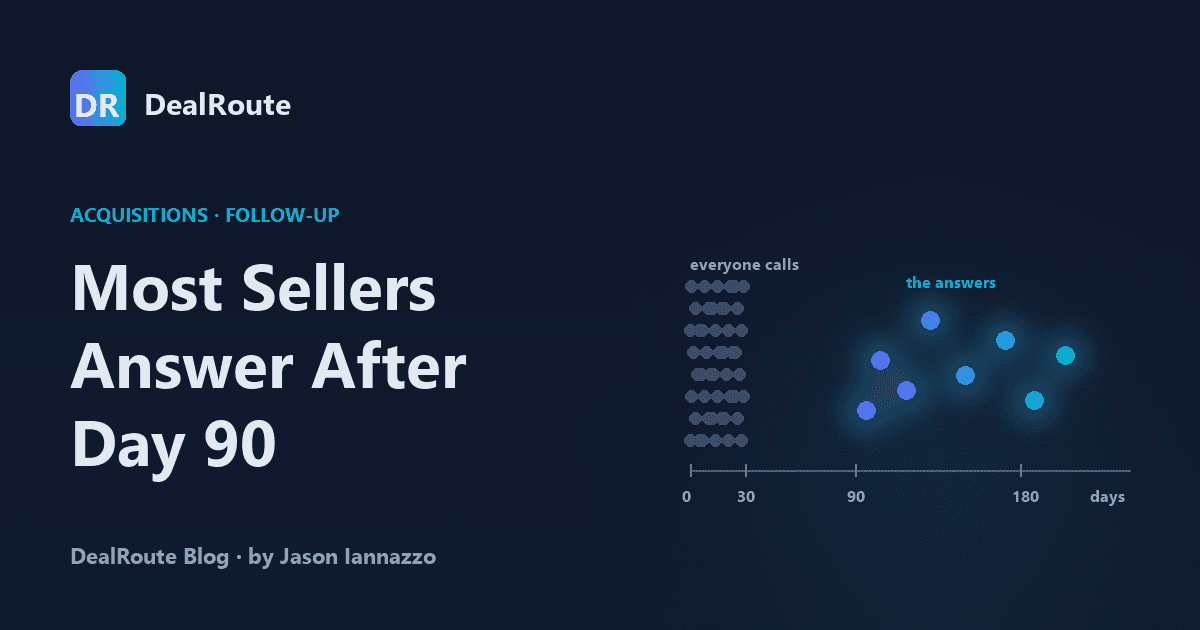
The middle seller answered about 98 days after their notice was recorded.
53 percent answered more than 90 days out. 26 percent answered more than 180 days out.
Only 18 percent, fewer than one in five, answered inside the first 30 days.
That last number is the one worth sitting with, because the first 30 days is where essentially all of the competition, and essentially all of the marketing spend, is concentrated.
Why the crowded window is the quiet one
Put yourself on the other side of it. The week a notice is recorded is the worst week of someone's year. It is also the week their phone starts ringing with strangers who all found out at the same time, because they all bought the same list on the same day.
Nobody answers in that week. Not because they are not motivated, but because answering means talking to a stranger about the most humiliating thing currently happening to them, and there are thirty of you.
Three months later, two things have changed. The initial panic has worn into something more like resignation, which is a state people actually make decisions in. And the phone has gone quiet, because everyone who bought that list has moved on to the next one.
That is when we hear back. Not because we said something clever on day 100. Because we were the only ones still there on day 100.
What this actually changes about how you operate
If most of your answers arrive after day 90, then the binding constraint on your business is not lead acquisition. You already have the leads. You bought them three months ago and wrote them off.
The constraint is whether you can still be present, in a way that is not annoying, on day 100, across every conversation at once, while also doing everything else.
That is a capacity problem, and it is the one thing a person working alone cannot solve by trying harder. You can force yourself through 40 follow-ups in an evening. You cannot do that every evening for four months across several hundred conversations, and the moment you stop, the conversations that were going to answer in month four quietly do not.
This is the whole reason I built what I built. Not to find more leads. To make sure the ones already in the system are still being spoken to in month four, when the answers actually arrive.
The honest caveats
This is one operator's pipeline in one state. 62 sellers is enough to see a shape and not enough to make a law. And it is 62 because most replies in this business are someone asking you to stop, which I left out on purpose: a stop is not an answer.
The notice-to-reply figure measures when someone replied to us, not when they became willing to sell. Those are related and they are not the same.
And the ATTOM numbers are a single month. One month is a data point and a trend is several.
What I would not do is keep aiming everything at the first 30 days on the assumption that being early is the edge. In my own numbers, being early is where fewer than one in five of the real answers live.
Pull the leads you wrote off in June and look at what you actually did with them. If the last touch was a breakup in week three, you did not test the market. You tested your own endurance.