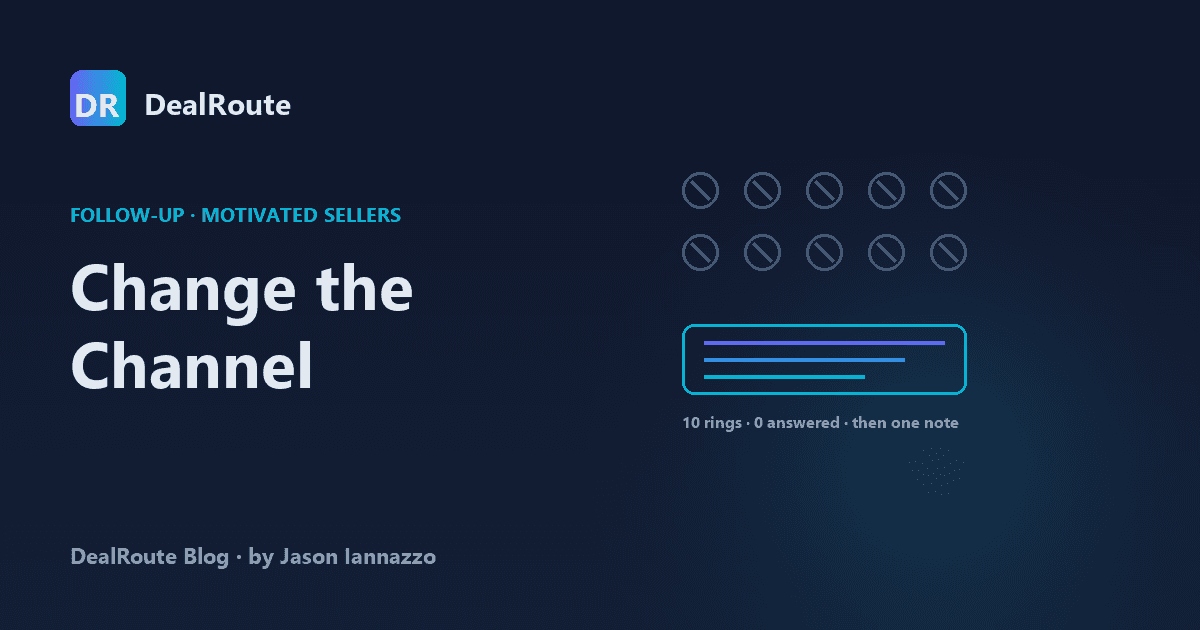
Ten rings is not ten follow-ups
Owners facing a sale date tend to have it handled, until they don't. In my experience that turn usually comes one to two weeks before the sale, and that is exactly when most follow-up quietly narrows to one channel.
Here is what it looks like. An owner we had already talked with, who wanted to meet, went quiet in the month before his sale. He had not been ignored: he was rung on ten different days and got seven voicemails. He returned none of them. What he had not had was anything in writing, for twenty days, because every unanswered call counted as the follow-up.
The screen looked busy. The one channel being used was the one that was not reaching him.
(If you want to see how much of your list you can actually reach, the free Pipeline Grader reads your real list rather than a questionnaire. We never store it, sell it, or message anyone on it.)
Why it happens to good operators
1. Attempts get counted as follow-ups. A call that rang out looks like activity. It is an attempt. If your rule is "wait a few days after the last outreach before following up," an unanswered call resets that clock every time, and the channel that is not working keeps being the only one used.
2. Follow-up rules are written for the cold end of the list. The owners you have already talked with, the ones closest to a decision, are the easiest to fall between rules.
3. Limits don't loosen as the date gets close. A cap on how often you re-open a quiet conversation protects an owner in month three. In the last week before a sale, the same cap is the reason they hear nothing.
None of these is careless. Each rule makes sense on its own. Together they produce weeks of the same unanswered channel at the worst possible time.
Four checks that catch it
1. Track which channel is connecting. An answered call, a reply, a note they wrote back to: those are connections. A call that rang out or went to voicemail is an attempt. If the last few attempts on one channel went unanswered, the next follow-up goes a different way.
2. List every owner with a date inside two weeks. For each one, write down when they last actually answered you, on which channel, and when the next follow-up is booked. A blank in either column is the whole problem.
3. Watch the owners who are further along more closely, not less. Check that every follow-up rule you have also covers the owners you have already talked with.
4. Give every cap a date exception. Keep a floor on spacing, but never let a limit be the reason someone hears nothing in the final week.
We changed all four in our own business: inside two weeks of a sale, only a written follow-up or a real conversation holds the clock, every owner we have talked with is covered, and the cap lifts until the date, still no more than one follow-up a week.
Common questions
How often should you follow up with a motivated seller? It depends on where they are. Months from a sale, a light rhythm and real patience. Inside the last two weeks, make sure something they will actually receive is always booked.
Does a voicemail count as a follow-up? It counts as an attempt to reach them. If an owner has stopped returning calls, another voicemail is the same attempt again. A short written note gives them a way to answer on their own time.
Why would a seller stop answering when you are reaching out constantly? Constant and reaching someone are measured differently. A screen full of calls can sit right next to weeks where the owner never once picked up, and nothing on that screen says to try another way.
When the phone stops connecting, change the channel.