What questions should you ask a motivated seller?
Start with what they want, then their timeline, then the money, then the house. One question at a time, in that order. Most investors start with the house, and they end the conversation with a list of repairs and no idea why the owner picked up the phone.
(Before you spend your time on conversations, the free Pipeline Grader shows how much of your list you can actually reach. Theirs reads a dropdown, ours reads your list. We never store it, sell it, or message anyone on it.)
Below are the 12 questions my team uses on a first real conversation. They are written the way we say them. You won't need all of them on one call. Start at the top and go as far as the conversation allows.
Why the order matters
The same house can be five different deals depending on what the owner wants. This fall we talked with one owner ten days from her sale who told us all she wanted was to be out from under it. We talked with another, four days from his, who was still planning to keep the house. Nothing on the list told us that. Only the first question did.
If you start with the roof, you get a roof. If you start with the person, you get the reason they answered.
Get these five first
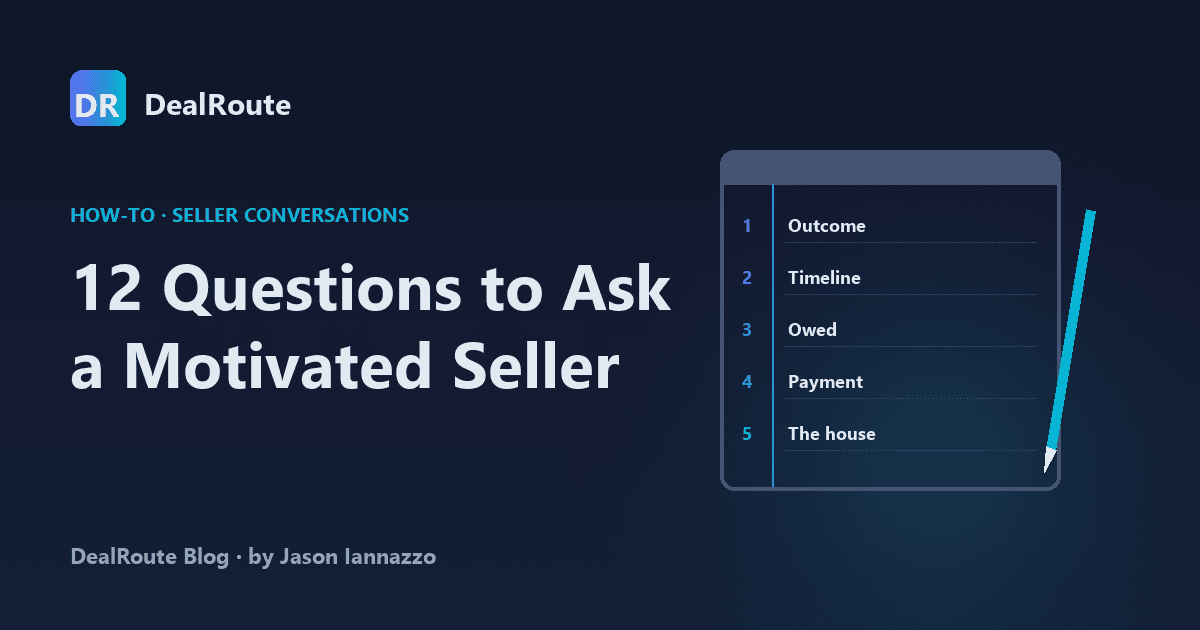
1. "What would the best outcome look like for you?" This tells you whether they want to keep the house or move on. Everything else is read through this answer.
2. "Is there a date on the calendar? Do you know the exact date?" For any timeline they give you, follow with: "Is that a deadline, or more of a preference?" A deadline changes what's possible. A preference changes how you follow up. If they give you a date that differs from your list, theirs is probably right.
3. "Roughly what's still owed on the house, and who's the lender?" A rough number is fine. It tells you which exits are even on the table.
4. "What's the monthly payment, with taxes and insurance? About how many payments behind are things?" This is the number that decides whether a hold or a subject-to has a chance.
5. "If a buyer walked through today, what would they say needs work?" Now you ask about the house, and you ask it in a way an owner can answer. Then go to the expensive things: roof, furnace, plumbing, beds and baths.
Then, if it's flowing
6. "If you're okay sharing, what's been going on that brought things to this point?" Nobody falls behind in one day. This is where you find out what actually happened.
7. "Is it just you on the loan and the title, or is someone else involved?" Then: "Is this more your decision, or one you'd make together?" The deed tells you who has to sign. The note tells you who gets hurt. They are not always the same people.
8. "Are you living in the house right now?"
9. "Is there anything else on the house, like a second mortgage, a home equity line, or judgments?"
10. "Are the property taxes current?"
11. "When did you buy the house, and roughly what did you pay?"
12. "Have you talked with anyone else about it, like an attorney, a realtor, or other companies?"
If they get overwhelmed by the numbers, ease off. "No need to have exact numbers. A rough idea is plenty, or we can come back to it."
How the answers point to an exit
You're not choosing an exit on this call. You're making sure you asked what each one needs.
- Wholesale (assign the contract to another investor): questions 3, 5 and 9. Your buyer will find everything you didn't ask about.
- Novation (fix what scares retail buyers and have a licensed agent list it): questions 1, 2 and 5. It takes longer, so the owner's timeline decides it.
- Subject-to (taking over the existing loan): questions 3, 4, 7 and 9. Balance, payment, who signed, and what else is on the house.
- Hold and rent: questions 4, 5 and 10. Does the payment work today, with room to spare?
Three rules that go with the list
- One question at a time. Ask it, then wait. Silence is fine.
- Never a number on the first conversation. Not an offer, not a range. The goal is to understand their situation and get in front of them.
- Don't answer what you're not qualified to answer. If they ask what a letter means or what happens next with the lender or the court, say so: "That part is really a question for an attorney." Then go back to the house.
Before you hang up
Play it back. "Let me make sure I heard you right," then sum it up in a few sentences, then ask: "What am I missing?"
Then write it down where you'll find it, in their words, with a date on the next step.
Common questions
What is the first question to ask a motivated seller? Ask what the best outcome would look like for them. It tells you whether they want to keep the house or move on, and it changes how you hear everything after it.
How many questions should you ask on a first call? As many as the conversation allows. Get the first five if you can. If the owner is overwhelmed, stop and come back. A person who feels heard will talk to you again.
Should you make an offer on the first call? We don't. We never give a number on the phone. The goal of the first conversation is to understand the situation and set up a time to sit down in person.
If you want to know how many of the owners on your list you can actually have this conversation with, the free Pipeline Grader reads your real list. Theirs reads a dropdown, ours reads your list. We never store it, sell it, or message anyone on it. And if an owner goes quiet after a good conversation, we wrote about what to do when the phone stops connecting.
Ask about them first. The house can wait ten minutes.