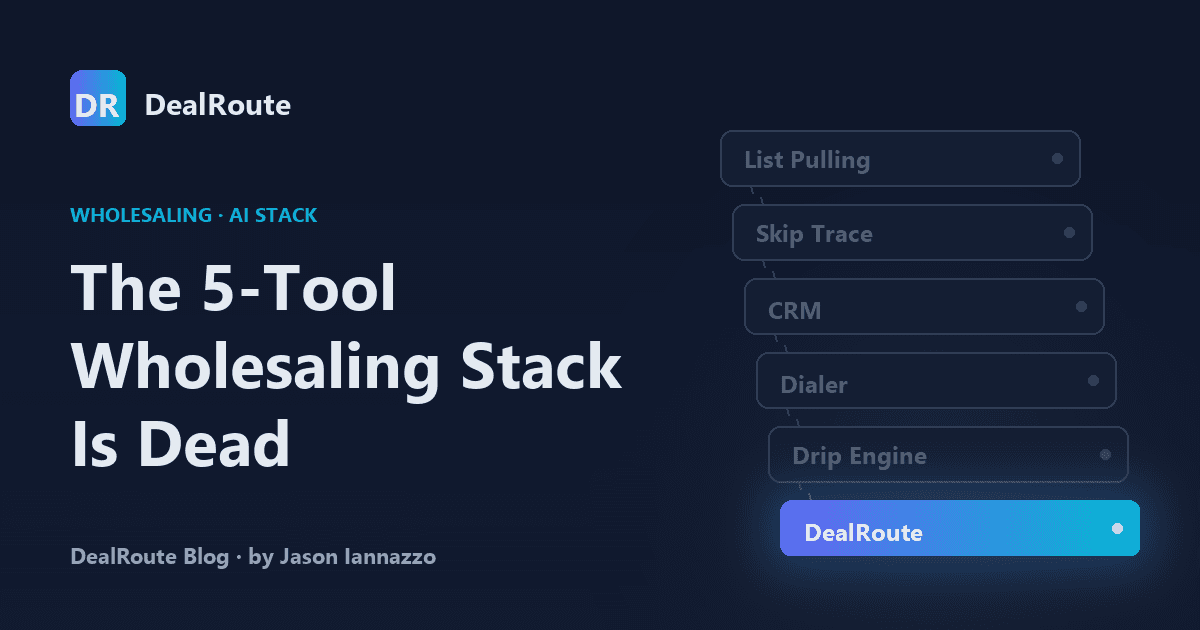
I used to run six tools to manage my wholesaling pipeline.
PropStream for qualification. DealMachine for list pulling and skip tracing. Mojo for calling. Twilio for the phone numbers. REI Simpli for automation. GoHighLevel for follow-up. Two to four hundred dollars a month, sometimes north of a thousand depending on which tools I had running. Fifteen hours a week just keeping the stack glued together.
And the leads suffered for it.
Here's what the actual workflow looked like. Pull a list in DealMachine. Skip trace it in DealMachine. Download to a CSV. Upload that CSV into PropStream to run qualification. Pick who to call. Re-upload that subset into REI Simpli or Mojo. Start outreach. Log responses in spreadsheets so I could keep track of who said what. Different login for every tool. Different dashboard for every tool. Zero continuity between them. No memory of who said what when, unless I built it myself.
That's not a stack. That's a juggling act.
The repetitive-work problem
Here's the part nobody tells you when they're selling you another point tool.
In a healthy wholesaling business, the repetitive work should run automatically — list pulling, skip tracing, qualification, outreach, follow-up scheduling, lead scoring. Your time should land on the things where your judgment is actually worth money — the live calls, the relationships, the offer decisions, the deals that move.
For most wholesalers I talk to, it's the opposite. Nearly all of their time goes to gluing the stack together, and the actual deals get whatever's left. Uploading CSVs. Downloading CSVs. Manually triggering skip traces. Double-entering the same lead into three systems. Watching deals fall through the cracks between tools.
I was that wholesaler. I'll tell you honestly — I almost wanted to quit. I was doing all this work and not seeing the results of it.
That's when something my IT background should have told me from the start finally clicked. Motivation is a feeling. Discipline is a system. When you have good systems, you become disciplined automatically — you can do the same things over and over without burning yourself out. The five-tool stack wasn't building discipline. It was destroying it.
The cloud-era shift
If you've been around tech for any length of time, this story should sound familiar.
Fifteen years ago every company had a server room. Racks of physical hardware. A guy whose whole job was patching servers, swapping drives, watching uptime. AWS came along and replaced all of that. Not by being a better server, but by being a different model entirely. Best-in-class point tools — physical servers, custom backups, hand-managed failover — became worst-in-class the moment one platform solved the integration problem.
The same shift happened to sales. Five separate sales tools — lead capture, CRM, dialer, email, reporting — got eaten by Salesforce. Not because Salesforce was the best at any single one of them, but because being the place where they all lived together was where the real value was.
Wholesaling is in that moment right now.
PropStream, DealMachine, REI Simpli are not bad tools. They were the right answer five years ago. But they're all bolting AI onto products that were designed pre-AI. The integration tax keeps growing. The data silos keep widening. The handoffs between them keep getting more brittle.
That handoff is where deals die.
What changes when one platform owns the whole flow
Three things compound.
First, AI gets full context on every lead. When the SMS thread, the voice transcript, the email open, the property condition score, and the title-search status are all in one place, the AI can actually be useful. When they're scattered across five tools, it can't.
Second, your job changes. You stop being the person who copies fields between tools. You become three things instead — the decision maker, the escalation point, and the orchestrator. You say yes or no on offers. You take the calls that need a human voice. You watch the flow and tune what the system handles on its own versus what gets routed to you.
Third, integrations stop being a tax and start being a moat. Every tool that talks natively to the others is leverage. Every API key you don't have to manage is time you don't lose.
The pushback I usually hear at this point is "just hire a VA for the busywork." I tried that too. Here's the problem. People get tired. People want to take breaks. People want to go on vacations. People get sick. People cost a lot of money. Computers will work twenty-four hours a day. They scale on demand. They don't burn out at 11 PM on a Friday in the middle of a follow-up sequence.
This is not another tool. It's a workflow shift. AI handles the routine — the SMS sequences, the email follow-up, the lead scoring, the routine qualification calls. You only touch the escalations and the decisions.
What I built instead
I built DealRoute around this thesis. AI first, from the beginning, not bolted on. One platform, end to end. You can turn off the automation if you don't want it, but the default is the system does the work for you.
It's the platform I wish existed when I was that wholesaler at one in the morning, copying lists between tools, almost ready to quit.
The honest caveat
AI can't fully replace a good wholesaler yet. There's a five to ten percent sliver of judgment that machines miss. Reading a seller's hesitation in real time. Knowing when to push on a contested term and when to walk. Building the title-rep relationship that takes fifty deals to earn. The platform's job isn't to replace any of that. It's to make sure the five percent of your attention that matters lands on the right five percent of leads.
The day will come where AI gets better at the gut-feeling parts too. The system gets smarter the more deals run through it. But that future is not here yet, and we should not pretend it is.
The thesis
The five-tool stack worked when this business was small.
At scale, it's a liability.
Jason Iannazzo is the founder of DealRoute and a Minnesota wholesaler. He spent 20+ years in IT and IT security before building DealRoute to be the platform he wishes had existed when he was patching together five tools at one in the morning.